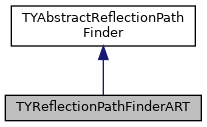
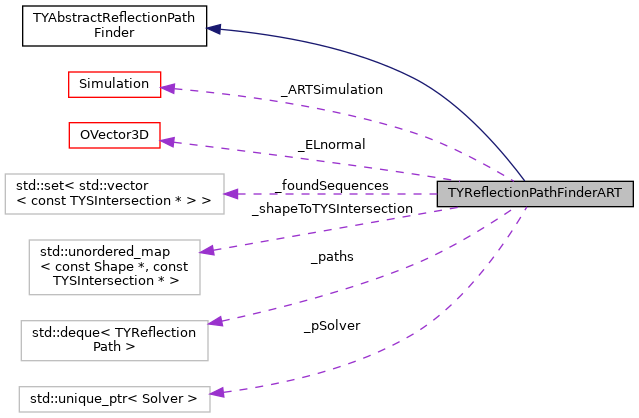
Reflection path finder relying on ray-tracing using the AcousticRaytracer module. More...
#include <TYReflectionPathFinder.h>
Public Member Functions | |
| TYReflectionPathFinderART (unsigned int nbRays, unsigned int accelerator=1, unsigned int maxTreeDepth=12, float rayMaxLength=5000.0f) | |
| std::unique_ptr< TYAbstractReflectionPathFinder > | instanciate () const override |
| Instanciate a new TYReflectionPathFinderART. The configuration of the former path finder (number of rays, ...) is transfered to the new instance. More... | |
| bool | setup (size_t maxOrder, const std::deque< TYSIntersection > &tabIntersect, const OPoint3D &source, const OPoint3D &receptor) override |
| Set the scene to be treated by the path finder. More... | |
| bool | remainingPaths () const override |
| Tell if some paths remain in the set of remaining paths. More... | |
| TYReflectionPath | popPath () override |
| Give the last computed reflection path, and remove it from the set of remaining paths. More... | |
 Public Member Functions inherited from TYAbstractReflectionPathFinder Public Member Functions inherited from TYAbstractReflectionPathFinder | |
| virtual | ~TYAbstractReflectionPathFinder ()=default |
Protected Member Functions | |
| TYReflectionPathFinderART ()=default | |
| void | setupConfiguration (size_t maxOrder) |
| Setup ART' Simulation configuration. More... | |
| bool | setupScene (const std::deque< TYSIntersection > &tabIntersect, const OPoint3D &sourcePoint, const OPoint3D &receptorPoint) |
| Build an AcousticRaytracer scene containing one source, one receptor, and a collection of faces. The faces are built from intersecting segments in EL-plane. Each segment is extruded along normal direction of EL-plane towards up and down directions of a certain length, to avoid singularities (ray-border of faces intersections) during ray tracing. More... | |
| void | setupAcceleratingDataStructure () |
| Setup accelerating data-structure using ART' Simulation configuration. More... | |
| void | setupSolver () |
| Setup ART' simulation solver. More... | |
| void | computeRaytracing () |
| Perform raytracing simulation. More... | |
| void | buildReflectionPaths (const OPoint3D &source, const OPoint3D &receptor) |
| Build reflection paths from valid rays found by the solver. For each sequence of reflecting barriers, only one path is built. More... | |
| bool | processIntersectingSegment (const TYSIntersection &inter) |
| Process an intersecting segment in EL-plane to add equivalent faces in the AcousticRaytracer' simulation scene. Intersecting segments which do not belong to EL-plane are ignored. More... | |
| void | buildQuadranglePointsFromInter (const TYSIntersection &inter, OPoint3D &p1Top, OPoint3D &p1Bottom, OPoint3D &p2Top, OPoint3D &p2Bottom) const |
| Compute points forming a quadrangle from an intersecting segment in EL-plane. Points are obtained by adding or substracting _extrusionLength along the normal direction of EL-plane to points forming the segment. More... | |
| void | addOrientedQuadrangle (const OPoint3D &p1Top, const OPoint3D &p1Bottom, const OPoint3D &p2Top, const OPoint3D &p2Bottom, const OVector3D vExt, const TYSIntersection &sourceInter) |
| Add an oriented quadrangle to the AcousticRaytracer' simulation scene. The quadrangle is oriented using a vector pointing towards the exterior of the quadrangle. The address of the intersecting segment from which come the quadrangle is used to map the added quadrangle to the intersecting segment. More... | |
| Shape * | addOrientedTriangle (const OPoint3D &p1, const OPoint3D &p2, const OPoint3D &p3, const OVector3D &vExt, const bool isSol) |
| Add an oriented triangle to the AcousticRaytracer' simulation scene. The vertices (v1 = p1, v2 = p2 or p3, v3 = p2 or p3) are set such that the normal of the triangle (v2-v1) x (v3-v1) is oriented the same than vExt. More... | |
| OVector3D | computeELPlaneNormal (const OPoint3D &source, const OPoint3D &receptor) |
| Compute a normal vector of the EL-plane Hypothesis: source and receptor are not aligned along a vertical line. More... | |
| bool | isPathValid (const TYReflectionPath &path) |
| Check if a path is valid. In plus of validation performed during raytracing, it has to be verified: More... | |
| bool | isPathAlreadyFound (const TYReflectionPath &path) const |
| Check if a path has already been found. More... | |
| bool | isLastSegmentIntersectingSceneElement (const TYReflectionPath &path) |
| Check if the last segment of a path intersects a scene element. More... | |
| Protected Member Functions inherited from TYAbstractReflectionPathFinder | |
| TYAbstractReflectionPathFinder ()=default | |
Private Member Functions | |
| void | computeRadiusFromDistanceSR (const OPoint3D &sourcePoint, const OPoint3D &rcptPoint) |
| Compute receiver radius from source and receiver points. More... | |
| FRIEND_TEST (test_ReflectionPathFinderART, computeELPlaneNormal_horizontalPlane1) | |
| FRIEND_TEST (test_ReflectionPathFinderART, computeELPlaneNormal_horizontalPlane2) | |
| FRIEND_TEST (test_ReflectionPathFinderART, computeELPlaneNormal_nonHorizontalPlane) | |
Private Attributes | |
| Simulation | _ARTSimulation |
| std::unique_ptr< Solver > | _pSolver |
| std::set< std::vector< const TYSIntersection * > > | _foundSequences |
| std::deque< TYReflectionPath > | _paths |
| std::unordered_map< const Shape *, const TYSIntersection * > | _shapeToTYSIntersection |
| unsigned int | _nbRays |
| unsigned int | _accelerator |
| unsigned int | _maxTreeDepth |
| float | _rayMaxLength |
| double | _rcptRadius |
| double | _extrusionLength |
| OVector3D | _ELnormal |
Detailed Description
Reflection path finder relying on ray-tracing using the AcousticRaytracer module.
Definition at line 83 of file TYReflectionPathFinder.h.
Constructor & Destructor Documentation
◆ TYReflectionPathFinderART() [1/2]
| TYReflectionPathFinderART::TYReflectionPathFinderART | ( | unsigned int | nbRays, |
| unsigned int | accelerator = 1, |
||
| unsigned int | maxTreeDepth = 12, |
||
| float | rayMaxLength = 5000.0f |
||
| ) |
Constructor
- Parameters
-
nbRays number of rays to spawn from the source
Definition at line 19 of file TYReflectionPathFinder.cpp.

◆ TYReflectionPathFinderART() [2/2]
|
protecteddefault |
Member Function Documentation
◆ addOrientedQuadrangle()
|
protected |
Add an oriented quadrangle to the AcousticRaytracer' simulation scene. The quadrangle is oriented using a vector pointing towards the exterior of the quadrangle. The address of the intersecting segment from which come the quadrangle is used to map the added quadrangle to the intersecting segment.
p1Top p2Top +---------—+ | | | | +---------—+ p1Bottom p2Bottom
- Parameters
-
p1Top p1Bottom p2Top p2Bottom vExt vector defining the exterior direction of the quadrangle sourceInter intersecting segment from which come the quadrangle
Definition at line 241 of file TYReflectionPathFinder.cpp.


◆ addOrientedTriangle()
|
protected |
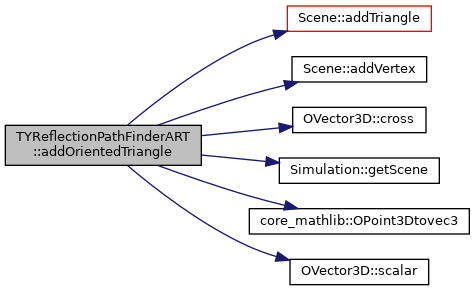
Add an oriented triangle to the AcousticRaytracer' simulation scene. The vertices (v1 = p1, v2 = p2 or p3, v3 = p2 or p3) are set such that the normal of the triangle (v2-v1) x (v3-v1) is oriented the same than vExt.
- Parameters
-
p1 first point p2 second point p3 third point vExt vector defining the exterior direction of the triangle
- Returns
- address of the added triangle
Definition at line 252 of file TYReflectionPathFinder.cpp.

◆ buildQuadranglePointsFromInter()
|
protected |
Compute points forming a quadrangle from an intersecting segment in EL-plane. Points are obtained by adding or substracting _extrusionLength along the normal direction of EL-plane to points forming the segment.
- Parameters
-
inter [in] intersecting segment from which creating the quadrangle p1Top [out] point created above the first segment point p1Bottom [out] point created below the first segment point p2Top [out] point created above the second segment point p2Bottom [out] point created below the second segment point
Definition at line 226 of file TYReflectionPathFinder.cpp.

◆ buildReflectionPaths()
|
protected |
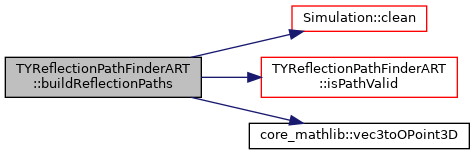
Build reflection paths from valid rays found by the solver. For each sequence of reflecting barriers, only one path is built.
- Parameters
-
source source point receptor receptor point
Definition at line 162 of file TYReflectionPathFinder.cpp.

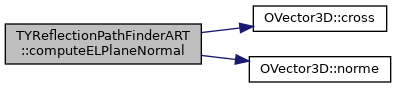
◆ computeELPlaneNormal()
|
protected |
Compute a normal vector of the EL-plane Hypothesis: source and receptor are not aligned along a vertical line.
- Parameters
-
source source point receptor receptor point
- Returns
- normal of EL-plane, normalized
Definition at line 281 of file TYReflectionPathFinder.cpp.

◆ computeRadiusFromDistanceSR()
|
private |
Compute receiver radius from source and receiver points.
- Parameters
-
sourcePoint Source point rcptPoint Receptor point
Definition at line 65 of file TYReflectionPathFinder.cpp.


◆ computeRaytracing()
|
protected |
Perform raytracing simulation.
Definition at line 157 of file TYReflectionPathFinder.cpp.


◆ FRIEND_TEST() [1/3]
|
private |
◆ FRIEND_TEST() [2/3]
|
private |
◆ FRIEND_TEST() [3/3]
|
private |
◆ instanciate()
|
overridevirtual |
Instanciate a new TYReflectionPathFinderART. The configuration of the former path finder (number of rays, ...) is transfered to the new instance.
Implements TYAbstractReflectionPathFinder.
Definition at line 38 of file TYReflectionPathFinder.cpp.
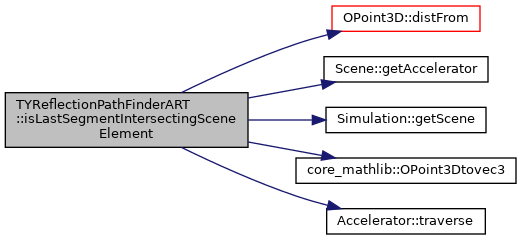
◆ isLastSegmentIntersectingSceneElement()
|
protected |
Check if the last segment of a path intersects a scene element.
- Parameters
-
path the path to check
- Returns
- true if the last segment of the path intersects a scene element
Definition at line 309 of file TYReflectionPathFinder.cpp.

◆ isPathAlreadyFound()
|
protected |
Check if a path has already been found.
- Parameters
-
path the path to check
- Returns
- true if the sequence of intersecting barriers of the path is the same than another path in _paths
Definition at line 304 of file TYReflectionPathFinder.cpp.

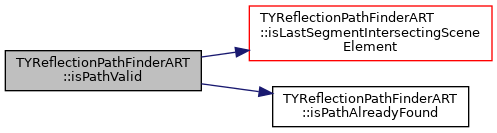
◆ isPathValid()
|
protected |
Check if a path is valid. In plus of validation performed during raytracing, it has to be verified:
- If the sequence of reflecting segments is new
- If the last step (last reflection point to receptor) does not intersect any scene element
- Parameters
-
path the path to check
- Returns
- true if the path is valid
Definition at line 291 of file TYReflectionPathFinder.cpp.

◆ popPath()
|
overridevirtual |
Give the last computed reflection path, and remove it from the set of remaining paths.
- Returns
- a reflection path
Implements TYAbstractReflectionPathFinder.
Definition at line 71 of file TYReflectionPathFinder.cpp.
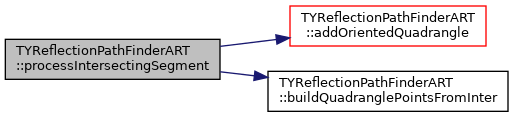
◆ processIntersectingSegment()
|
protected |
Process an intersecting segment in EL-plane to add equivalent faces in the AcousticRaytracer' simulation scene. Intersecting segments which do not belong to EL-plane are ignored.
The triangles forming the face are oriented so that the normal of the triangles point towards the same direction than the normal of the face whose cut produced the intersecting segment. This way, it is guaranteed that any intersection between a ray spawned outdoor and one of the triangles forming the face are found.
          +    ^
         /|   /  normal of the face from which the intersecting segment comes
- + | / —> ||-> normal of the triangles added
| + |/
- Parameters
-
inter intersecting segment to process
- Returns
- true if the intersecting segment has been correctly processed
Definition at line 202 of file TYReflectionPathFinder.cpp.

◆ remainingPaths()
|
overridevirtual |
Tell if some paths remain in the set of remaining paths.
- Returns
- true if at least one path can be obtained from
popPath
Implements TYAbstractReflectionPathFinder.
Definition at line 60 of file TYReflectionPathFinder.cpp.
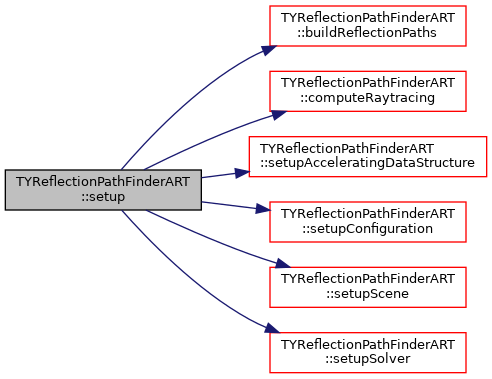
◆ setup()
|
overridevirtual |
Set the scene to be treated by the path finder.
- Parameters
-
maxOrder maximum order of the reflection paths to find tabIntersect set of intersecting segments of the scene source source point from which reflection paths must start receptor receptor point to which reflection paths must end
- Returns
- true if setup succeeded
Implements TYAbstractReflectionPathFinder.
Definition at line 44 of file TYReflectionPathFinder.cpp.
◆ setupAcceleratingDataStructure()
|
protected |
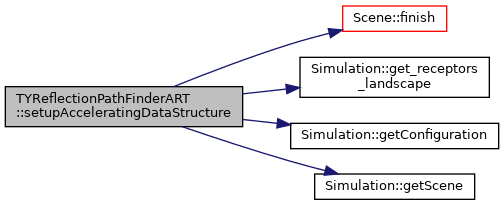
Setup accelerating data-structure using ART' Simulation configuration.
Definition at line 130 of file TYReflectionPathFinder.cpp.

◆ setupConfiguration()
|
protected |
Setup ART' Simulation configuration.
Definition at line 85 of file TYReflectionPathFinder.cpp.


◆ setupScene()
|
protected |
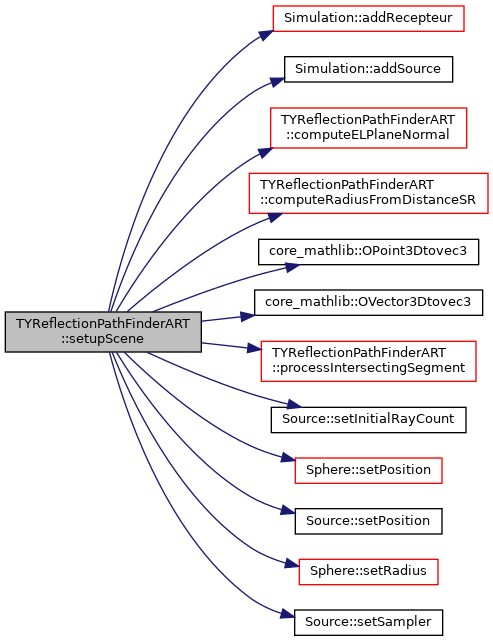
Build an AcousticRaytracer scene containing one source, one receptor, and a collection of faces. The faces are built from intersecting segments in EL-plane. Each segment is extruded along normal direction of EL-plane towards up and down directions of a certain length, to avoid singularities (ray-border of faces intersections) during ray tracing.
Rays are sampled uniformly in EL-plane, the number of rays being controlled by _nbRays. The receptor is modelled as a sphere, controlled by _rcptRadius.
- Parameters
-
tabIntersect set of intersecting segments of the scene sourcePoint location of the source receptorPoint location of the receptor
- Returns
- true if the faces have successfully been built
Definition at line 91 of file TYReflectionPathFinder.cpp.

◆ setupSolver()
|
protected |
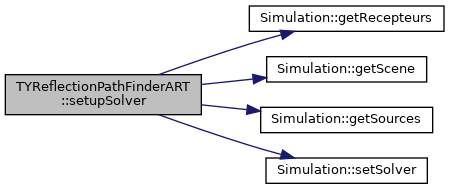
Setup ART' simulation solver.
Definition at line 146 of file TYReflectionPathFinder.cpp.

Member Data Documentation
◆ _accelerator
|
private |
Definition at line 283 of file TYReflectionPathFinder.h.
◆ _ARTSimulation
|
private |
Definition at line 277 of file TYReflectionPathFinder.h.
◆ _ELnormal
|
private |
Definition at line 288 of file TYReflectionPathFinder.h.
◆ _extrusionLength
|
private |
Definition at line 287 of file TYReflectionPathFinder.h.
◆ _foundSequences
|
private |
Definition at line 279 of file TYReflectionPathFinder.h.
◆ _maxTreeDepth
|
private |
Definition at line 284 of file TYReflectionPathFinder.h.
◆ _nbRays
|
private |
Definition at line 282 of file TYReflectionPathFinder.h.
◆ _paths
|
private |
Definition at line 280 of file TYReflectionPathFinder.h.
◆ _pSolver
|
private |
Definition at line 278 of file TYReflectionPathFinder.h.
◆ _rayMaxLength
|
private |
Definition at line 285 of file TYReflectionPathFinder.h.
◆ _rcptRadius
|
private |
Definition at line 286 of file TYReflectionPathFinder.h.
◆ _shapeToTYSIntersection
|
private |
Definition at line 281 of file TYReflectionPathFinder.h.
The documentation for this class was generated from the following files:
- /home/docs/checkouts/readthedocs.org/user_builds/code-tympan/checkouts/latest/Tympan/solvers/9613/9613Solver2024/TYReflectionPathFinder.h
- /home/docs/checkouts/readthedocs.org/user_builds/code-tympan/checkouts/latest/Tympan/solvers/9613/9613Solver2024/TYReflectionPathFinder.cpp